Wednesday, August 25, 2010

Web quest for 201 (27 August 2010)

Dear 201 students,

Please kindly take the 1 hour lesson time to construct the following glossary for your own use, together with suitable pictures and answer the following questions which will need to be handed in at the end of the lesson.

TASK A: Make your own weathering glossary

Prepare a glossary of weathering terms based on information from physicalgeography.net. Include pictures where applicable. Definitions should be phrased in a paragraph and be sequential in its explanation. This can be a group effort. Submit the soft copies to Mrs Lim at nhsczm@nus.edu.sg. Make sure your names are at the back of the glossary you made.

  1. Weathering
  2. Denudation
  3. Scree
  4. Talus
  5. Physical weathering
  6. Chemical weathering
  7. Biological weathering
  8. Frost shattering
  9. Insolation weathering
  10. Exfoliation
  11. Sheeting
  12. Solution
  13. Carbonation
  14. Hydrolysis
  15. Oxidation
  16. Reduction
  17. Regolith
TASK B: Individual work

Answer the following questions on writing paper. Remember to indicate your name and mentor group.

1. Contrast and compare frost shattering and insolation weathering. (9m)
2. Explain how carbonation occurs and suggest 3 conditions that will lead to formation of limestone landforms. (8m)

Submit TASK B at the end of the lesson. The Geog Rep (Jason) should collect everyone's TASK B and submit to a teacher in charge or to Mrs Lim's pigeon-hole (no. 86).

Online resources:


Sunday, August 1, 2010

Mount Saint Helen

Here's some background and updated information on Mount Saint Helen.


First, background and update until 2007.


An a recent video uploaded to argue for more funding to continue monitoring Saint Helen. When people are asking for money, their videos are slightly more clear. :)


Thursday, April 8, 2010

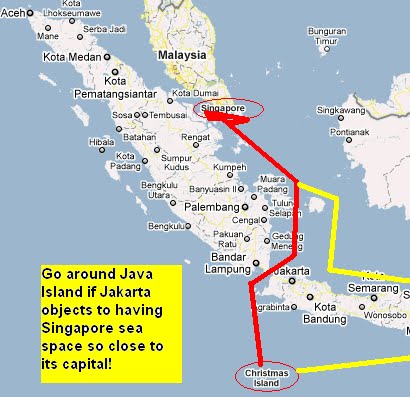
If Singapore had kept Christmas Island...


M10203 was looking at the map of South-east Asia and remembering the territories of ASEAN countries and was also briefly discussing what happens at boundaries. When we were talking very briefly about what would happen to Singapore territories if we had kept Christmas Island.

Well, then Indonesia would have this funny sea space (as illustrated by the red line) cutting through their sea space, and Singaporean sea space passing dangerously close to Jakarta area! The Indonesian fishermen from the Sumatra island will also find themselves suddenly cut off from the full access of the Java Sea and Singapore will suddenly own a part of the Java Sea!

Well, it is all my imagination. The yellow line is another ridiculous thought of MORE sea space if Indonesia allows this to happen. Wahaha. Well, this is in my own imagination.

Using the 1982 United Nations Convention on the Law of the Sea however, it will look more like this below, where Singapore will be made up of 2 red dots! well, at least it is one more red dot.

Wednesday, March 3, 2010

IH2101 E-learning Week (Week starting 8 March 2010)

To all IH2101 students,

We are starting on a new topic in E-learning Week. Please follow the instructions in this post to fulfil the learning required in this week. This assignment will lead to examining governance in transnational companies (TNCs) and their impact in governance in their host or home countries.

Normal catching up with the last topic like the Dr Tan activity or civil societies reading discussion/activity will still take place on Monday or the following week after the March holidays.

Our Essential Questions in this new topic:

1. What are the roles and contributions of SMEs and TNCs to the growth and progress of the nation?

2. How does government encourage and support SMEs and TNCs?

SME = Small, medium enterprises that are privately owned by individuals. It usually refer to companies started up by Singaporeans in the local context. This term has also been used to describe private firms from Taiwan and Hong Kong.

TNC = Transnational company that have operations in more than one country other than its country of origin. Companies like Nike, Nestle, Shell and Ikea are all TNCs.

+++++++++++++++++++++++++++
- E-learning Activity - Singapore's One North - Reflection Entry and Short Essay -
This activity should be done in 1-2 hours. It should not take more than 2 hours.

Section A: Each response in Section A should have a word count of 50 to 100 words (max).

Source A: Read the special report on One-North at http://www.businessweek.com/innovate/content/jun2009/id2009061_019963.htm.
You should also watch the video interview.

Answer the following questions.

1. How does the creation of One-North support the development of science-related industries?

2. Why do you think Singapore wants to attract science-related industries to Singapore?

3. How do you think the presence of big science-related companies will benefit the development of SMEs in Singapore?

----------------------------------------------------------
Section B: Read Source B below and write a short essay (word count 400 to 500 max). Bear in mind that you need an introduction, main body and conclusion. You can draw on keys ideas from Section A.

Source B: Ensuring the Transfer of Skills and Technology and Maintaining a Competitive Edge

"The transfer of skills and technology between people is known as the transfer of tacit knowledge. Many governments around the world are now aware that the intangible interactions between talents are the key activity that ensures value creation. This transfer of skills, technology and knowledge is thus the key differentiation between science parks that work, and those that will not. How governments can create the best environment for such interactions is thus a great challenge."

1. Evaluate One-North as Singapore's strategy in attracting science-related industries. Explain your answer.

Submit your reflection and essay to your respective IH teachers' pigeonholes on 12 March 2010 when you return to school for House Carnival. The IH representatives or Mentor Representatives will assist in collating the assignments as a class and submit together by 12pm on 12 March 2010.


Monday, January 25, 2010

An example of when a union fight back


In this class journal, you need to watch this video and answer questions in Section A and B.

Section A: Short response questions:

  1. What was the main reason why writers of television shows and dramas were paid lowly in the 1980s?
  2. How has technology change for the US television industry? How has it benefit them?

Section B: Structured response questions (longer responses in 2-3 paragraphs, each paragraph about 80 to 120 words)

  1. To what extent do you agree that the writers have a 'right' to have a strike?
  2. Based on this writers' strike example, how useful is a trade union?

*a strike means they do not work and demand conditions that the bargain for to be accepted before they go back to work.

Watch the video below and answer the questions in Section C.


Section C: Structured response questions (longer responses in 2-3 paragraphs, each paragraph about 80 to 120 words)

1. What is the advertisement trying to say about union bosses?

2. Compare the messages in the 2 videos. Explain 1 advantages and 1 disadvantage associated with unions.


You will be given class time to watch the videos one time in class. You should watch these two videos again when completing your assignment at home.

Monday, October 5, 2009

E-learning on communism

Dear HS1102 students,

Welcome to Mrs Lim's personal geography blog. I'm hosting the HS1102 E-lesson instructions here for the time being until I work out one entire integrated humanities website for 2010. Yes, it will be a website, not a blog. I've lost my interest in blogging as a teacher after 3 years of trying to make it work well for teaching purposes. I still think a website will be better in the long run. The good thing is, all my resources are here in this blog. My website will be like a long content page next time...

Today's E-lesson (intro lesson to alternative development)
Today's lesson is a self-directed learning on communism. The purpose of this lesson is simple. It is simply to find out what information is available on the Internet on communism. As this is self directed, you can choose to explore communism in the following 3 ways.

Get to know who else is in the same topics as you so we can form expert groups (members are have the same topic) and jigsaw groups (mixture of members with different topics) in the next lesson.

1. Communism and politics
A. Start off read about communism, socialism and capitalism on wikipedia.
B. Go to The Chairman Smiles website: http://www.iisg.nl/exhibitions/chairman/ and write down your responses on reading and looking at the posters that comment on communism as a political system.

2. Communism and Socialism: What are the differences?
A. Start off read about communism, socialism and capitalism on wikipedia.
B. Visit this socialism website: http://home.vicnet.net.au/~dmcm/Articles/nutshell.htm and first: do not believe everything you read there. Try to figure out what he is saying and what is his purpose in presenting socialism in the way he is doing on his website. Write down your responses.

3. Socialism Today?
A. Start off read about communism, socialism and capitalism on wikipedia.
B. Read this article that argues that US President Obama is not a socialist. Link is here: http://www.washingtonpost.com/wp-dyn/content/article/2009/03/13/AR2009031301899.html. What is socialism? According to the article, what are the key characteristics of socialism? Write down your responses.

4. Communism and development
A. Start off read about communism, socialism and capitalism on wikipedia.
B. Visit http://en.wikipedia.org/wiki/List_of_current_communist_states to know which are the current communist states/countries in the world today. Do you think they all have similar stages of development? Visit http://www.suite101.com/article.cfm/east_asian_history/103959 to read about the achievements of Communism in East Asia and Poland's case in http://www.suite101.com/article.cfm/polish_baltic_history/66634. What can you conclude about communism as a alternative form of development?

Come to class next lesson to be prepared to do discussions in expert groups and jigsaw groups.


Tuesday, June 23, 2009

Welcome to HS1102

Dear HS1102 students, a short and quick welcome to this module. We will be focusing on development and how it affects countries. We will be using Singapore and regional countries as case studies throughout the module and also employing critical thinking you came across in HS1101.

To start some thinking - here are some questions for you to prepare for the first lesson of this module.

1) What is development? 
2) How long do you think it has been happening?
3) How has development changed Singapore?